
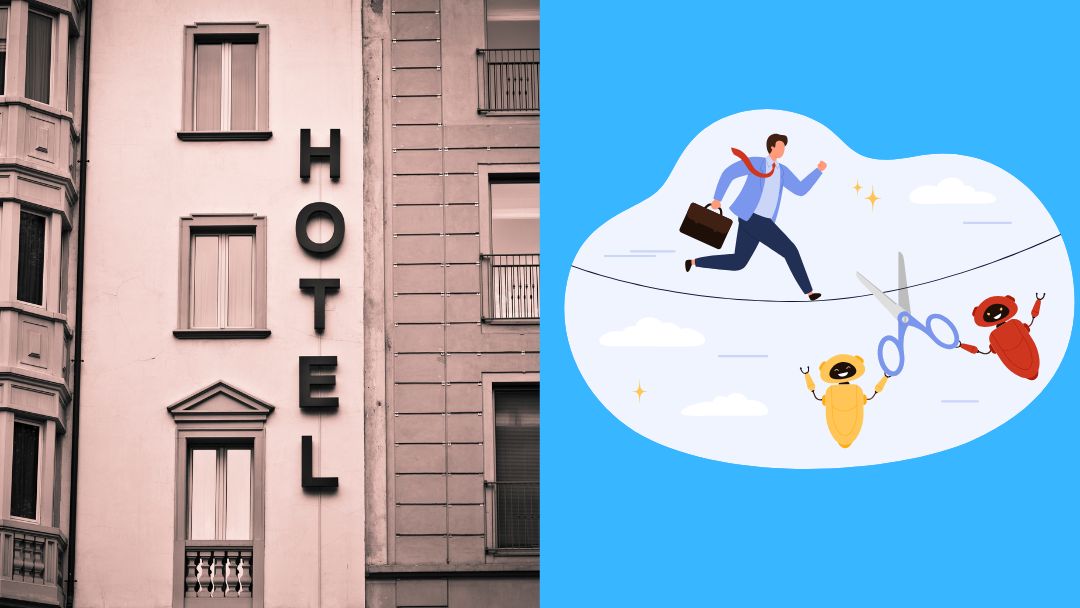
The industry is quietly crossing the line from AI that advises to AI that acts. The hotels that navigate it well will not be the ones that hand over the keys, or the ones that refuse to.
For the last few years, AI in hotels has mostly been an advisor. It analyzed, it forecasted, it recommended, and a human decided what to do. That arrangement felt safe, because an advisor you can ignore. If the recommendation was wrong, a person caught it before anything happened.
That arrangement is ending, and faster than most hotels realize. The technology is crossing a line from advising to acting, from telling you what is happening to doing something about it: adjusting a rate, sending a message, shifting distribution, flagging a labor issue, and recommending the fix while there is still time to make it. This is not a distant prediction. At HITEC 2026, the industry’s largest technology event, the dominant theme was not a new tool. It was governance, the growing recognition that AI agents are becoming operational infrastructure and that hotels now need a way to oversee the decisions those agents make. When the biggest conversation in hotel technology shifts from “what can AI do” to “how do we keep control of what it does,” something real has changed.
I want to talk about that shift, because it is the most important one happening in hotel AI right now, and it raises a question every hotel will soon have to answer, whether they mean to or not.
The line between advising and acting is bigger than it looks
An AI that advises and an AI that acts sound like small variations on the same thing. They are not. The difference is the whole game, and it comes down to what happens when the AI is wrong.
An advisor that is wrong costs you nothing if a human catches it, because the human is the checkpoint between the recommendation and the action. An AI that acts removes that checkpoint. When the system sets the price, sends the message, or shifts the inventory on its own, a wrong decision does not wait for anyone to catch it. It executes. And because these systems act fast and at scale, a poor decision does not happen once. It can happen across every room type, every channel, every future date, or every property in a portfolio, before a human notices.
This is the real reason governance suddenly matters. It is not bureaucratic caution. It is that the safety net, the human standing between the machine’s judgment and the guest’s experience, is exactly what gets removed when AI moves from advising to acting. Someone has to decide, deliberately, where that net stays and where it comes down. If no one decides, it comes down by default, one convenient automation at a time, until a hotel is being run by decisions nobody is actually watching.
The two wrong answers
Faced with this shift, there are two easy responses, and both are mistakes.
The first is to hand over the keys. Enthusiastic adopters, under pressure to move fast and show results, let the systems act because it is efficient and the demos are impressive. They enable autonomous pricing, automated guest messaging, agent-driven distribution, and they do it without building the oversight that should come with it. For a while it works, and then a system does something no human would have done, prices a sold-out night wrong, sends a tone-deaf message at the wrong moment, chases a demand signal that made no sense for the local market, and because no one was watching, it is already done, at scale, before anyone knows.
The second wrong answer is to refuse. Cautious operators, rightly wary of the risk, keep AI firmly in the advisor seat and let competitors pull ahead on speed and responsiveness. This feels safe, but it is its own kind of loss, because the ability to act on a signal faster than a human can is a genuine advantage, and refusing it entirely leaves real value on the table. The hotel that will only ever let AI advise is choosing to be slower than it needs to be, forever.
The right answer is neither. It is not “let the machine act,” and it is not “never let the machine act.” It is deciding, deliberately and in advance, which decisions AI is allowed to make, under what conditions, with what human checkpoint, and with what ability for local judgment to override it. That deciding is the work. It is not a technology question. It is a governance question, and it is exactly the thing most hotels have not done.
What the deciding actually looks like
This does not have to be complicated, and it is worth being concrete, because “governance” can sound abstract until you break it into the actual decisions.
For any place you are considering letting AI act rather than just advise, a few questions settle it. What exactly is this system allowed to do on its own, and what must it bring to a human first? What is the boundary it cannot cross without approval: the rate floor, the ceiling, the kind of message, the size of the move? Who owns the outcome when it acts, because responsibility has to sit with a named person, not with the machine? At what confidence level should it act automatically versus flag for review? And crucially, can a human override it, and when they do, is the reason captured so the system and the team actually learn?
Notice what this framework does. It lets AI act where acting is safe and valuable- the routine, the time-sensitive, the well-bounded- while keeping a human firmly in charge of the decisions that carry real risk or need local context the machine does not have. It is not a brake on AI. It is what lets you use AI’s speed without being blindsided by its mistakes. The best revenue leaders in the industry already work this way, drawing a hard line between automated execution inside human-set guardrails and genuine autonomous decision-making, letting the system optimize within bounds the human defines rather than handing it the whole decision. That is the model, and it scales to every part of the hotel where AI is starting to act.
Why the human matters more, not less
There is an assumption buried in all of this worth dragging into the light. People assume that as AI gets better at acting, the human becomes less important. The opposite is true. The moment AI starts acting is exactly when human judgment becomes most valuable, because the human is no longer doing the routine work the machine now handles. The human is doing the thing only a human can do: setting the boundaries, holding the local context the machine lacks, catching the decision that is technically defensible and locally wrong, and owning the outcome.
A revenue manager who used to spend the morning pulling data and adjusting rates by hand is not made redundant by an agent that does that work. They are elevated to the more important job of deciding what the agent is allowed to do, watching where its judgment meets the edge of what it understands, and overriding it when they know something it does not: the wedding down the road, the construction that will hurt the view, the loyal guest the system would price away. The machine acts. The human governs. And governing well is harder and more valuable than the work the machine took over, which is why the hotels that thrive will be the ones that invest in that human judgment rather than assuming the machine replaces it.
This is the same truth underneath everything I believe about AI in hotels. It amplifies people rather than replacing them, and never more so than when it starts to act, because acting without human judgment behind it is just fast mistakes, while acting with human judgment behind it is a genuine advantage.
The question before the decision
So here is where this lands. AI is crossing the line from advising to acting in your hotel, whether or not you have decided to let it. Every automation you enable, every agent you switch on, every “let the system handle it” is a small crossing of that line, and if you make those crossings by default, one convenient tool at a time, you will end up with a hotel run by decisions nobody is governing.
The question to answer before that happens is simple to ask and takes real thought to answer. For each place AI could act instead of advise, have you decided, on purpose, what it is allowed to do, where the human stays in charge, and who owns the outcome? A hotel that can answer that is ready to use AI’s speed safely. A hotel that cannot is handing over the keys without knowing it.
The technology will keep moving from advising to acting. That part is not your choice. What is your choice, and what will separate the hotels that thrive from the ones that get quietly burned is whether the acting happens by your design or by default. Decide on purpose, keep the human where the human belongs, and let the machine act only where you have chosen to let it. That is not resisting the future. It is being ready for it.
The compass is ready. The direction is yours.
Frequently Asked Questions
What is the difference between AI that advises and AI that acts in a hotel?
AI that advises analyzes data and recommends actions, leaving a human to decide whether to carry them out, so a human checkpoint sits between the recommendation and the result. AI that acts, often called agentic AI, executes decisions on its own within set parameters, such as adjusting rates, sending guest messages, or shifting distribution, without waiting for human approval each time. The distinction matters because an advisory system’s mistakes can be caught before they take effect, while an acting system’s mistakes execute immediately and at scale. As hotels adopt agentic AI, the key task becomes deciding which decisions the system may make autonomously and which require human approval.
Is it safe to let AI make autonomous decisions in a hotel?
It can be, when it is bounded by deliberate governance rather than switched on by default. The safe approach is semi-autonomous: the AI acts only within limits a human sets, such as rate floors and ceilings, with clear rules about what it can do alone and what it must bring to a person first. Leading revenue teams draw a firm line between automated execution inside human-defined guardrails and full autonomous decision-making, letting the system optimize within bounds rather than handing over the entire decision. The risk comes not from AI acting, but from AI acting without anyone having decided its boundaries, its human checkpoints, and who owns the outcome.
Why was governance the big theme at HITEC 2026?
Because hotels are deploying AI agents across revenue management, marketing, reservations, maintenance, finance, and guest communications, and the industry recognized that these agents are becoming operational infrastructure that makes thousands of automated decisions with too little oversight. The concern is that without a governance layer, a hotel can end up running on automated decisions nobody is actually watching or accountable for. This drove interest in ways to take stock of and oversee an organization’s full set of AI agents, so that the speed of automation does not come at the cost of control, coherence, and accountability.
Does agentic AI mean hotels need fewer people?
Not in the way it is often assumed. When AI takes over routine execution, human judgment becomes more important, not less, because the human role shifts to the higher-value work the machine cannot do: setting the boundaries the AI operates within, holding the local context the system lacks, catching decisions that are technically defensible but locally wrong, and owning the outcomes. A revenue manager whose routine tasks are automated is elevated to governing what the system is allowed to do and overriding it with knowledge it does not have. The hotels that benefit most treat AI as something that amplifies skilled people rather than replaces them.
How should a hotel decide which decisions to let AI make?
By working through a clear set of questions for each potential use before enabling it. What exactly is the system allowed to do on its own, and what must it escalate to a human? What boundary can it not cross without approval? Who owns the outcome when it acts? At what confidence level should it act automatically versus flag for review? And can a human override it, with the reason captured so the team and the system learn? This framework lets AI act where acting is safe and valuable- the routine and well-bounded decisions- while keeping humans in charge of choices that carry real risk or require local knowledge, which is how a hotel gains AI’s speed without being exposed to its mistakes.
👉 Next Steps
The future of hotels isn’t about flashy gadgets; it’s about embedding intelligence into your very DNA. Dive below the surface and discover the hidden engine that will reinvent everything you thought you knew about hospitality.
See you beneath the waves!
And if you’re ready to take the first step, I invite you to join me for a complimentary 60-minute Hotel AI Consultation. Together, we’ll unlock what AI can do for your brand. Send me an email to learn more.
Ready to Transform Your Hotel? Discover how AI and innovative education can redefine hospitality. Let’s start the conversation!
Contact me today to discuss how we can leverage your hotel’s AI, social media, and creative content to revolutionize your hotel and create a truly unique and unforgettable guest experience.
This collaboration will allow us to:
- Assess your specific needs and goals: We’ll work together to identify the key areas where AI can make the biggest impact on your business.
- Develop customized AI agent personas: We’ll craft AI agents that embody your brand and resonate with your target audience.
- Implement and integrate AI solutions: We’ll seamlessly integrate AI into your existing systems and workflows, ensuring a smooth transition and minimal disruption.
- Provide ongoing support and optimization: We’ll continuously monitor and refine your AI agents to ensure they’re delivering exceptional results.
By partnering together, we can create a truly exceptional hospitality culture where AI and humans thrive together and provide a thrilling experience for everyone involved. Let’s shape the future of hospitality together.
Over to you
The hotel industry is always changing, especially during a time of crisis. Make sure to future-proof your business and continue attracting new guests by investing in these solutions.
Propel Your Hotel’s Success with an AI Champion!
Don’t let your hotel be left in the shadows of its competitors!
Take charge of your future and embrace the digital revolution by reaching out to Are Morch – the visionary AI and Digital Transformation Coach who is poised to lead you towards an exciting, prosperous future.
Contact us today and embark on the most thrilling chapter of your hotel’s journey!
Related article: The Genesis of AI in Hospitality: A Prelude to Personalization
Where can you reach me?
Email: hotelblogger@aremorch.com
NEW: Hotel Digital Transformer on LinkedIn
Also, join us on our Facebook group, Hotel Social Media Community.
About Are Morch
🚀 AI Hotel Coach | Digital Transformation Expert | AI Champion
With a passion for revolutionizing the hospitality industry, I help hoteliers work smarter, not harder, by embracing AI, digital transformation, and innovation. My mission? To bring people and technology together to transform hotels, creating uncontested market experiences through service, confidence, cooperation, and purpose – empowering your team to elevate the guest experience and community.
Follow me for insights, strategies, and fresh perspectives on how AI is shaping the future of hospitality!
Let’s reimagine the industry, one breakthrough at a time!
Get more from Are on Facebook | Twitter | LinkedIn | Pinterest | Instagram| Podcast | YouTube


