
Most boutique hotel owners I talk to are not struggling with whether to adopt AI. They have already accepted that it matters. What they are struggling with is the question that comes immediately after that acceptance: how do I actually do this without breaking the operation that is already running at full capacity with a team that is already stretched thin?
That is the right question, and almost nobody in the industry is answering it honestly.
The vendor answer is to buy the platform and figure out the rest later. The consultant answer is to commission a strategy that looks impressive and sits in a drawer. Neither of those serves a thirty-room property where the owner is also the revenue manager, the front desk supervisor, and the person who handles the maintenance call at midnight.
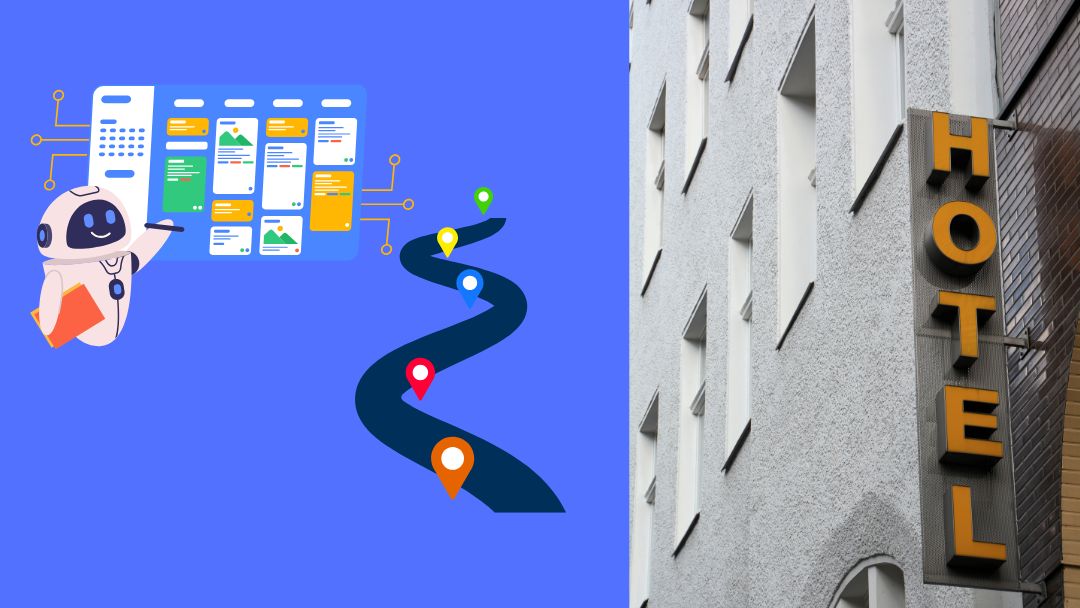
This is a different kind of answer. It is a twelve-month roadmap built around the reality of how a boutique hotel actually operates, sequenced so that each phase funds and enables the next, and designed so that the guest never feels the transition happening. By the end of it you will understand not just what to do but in what order to do it, and why the order matters more than almost any individual tool decision you will make.
Why Boutique Hotels Need a Different AI Strategy
A boutique hotel AI strategy cannot be a scaled-down version of an enterprise strategy. The constraints are different, the advantages are different, and the sequence that works is different.
The enterprise hotel has a coordination problem. Too much data flowing through too many systems, too many approval layers between insight and action. The boutique hotel has the opposite challenge. The intelligence the operation generates every day, the guest preferences, the booking patterns, the operational signals, often lives in one person’s head and disappears at every shift change. The boutique AI problem is not coordination. It is capture.
This distinction shapes everything. It means the boutique hotel should not begin by trying to optimize a complex system. It should begin by building the capacity to capture and use what it already knows. That is a smaller, faster, and far less disruptive starting point than the enterprise playbook suggests.
There is also a competitive advantage hiding in the constraint. Every major chain and every large OTA is investing in AI to do the same things at scale: automate transactions, reduce cost per interaction, optimize distribution. They are all competing in the same ocean with the same tools. The boutique hotel that uses AI to do something scale cannot replicate, to know its guests more deeply and respond to them more personally, is competing somewhere else entirely. That is the Blue Ocean available to independent hospitality, and a good AI roadmap is built to move you toward it rather than toward parity with the chains.
This is the same principle that applies to AI for small hotels of any size.
The Principle That Should Govern Every Decision
Before the roadmap itself, one principle needs to be clear because it determines whether the whole effort succeeds or fails.
AI should amplify human judgment, not replace it. When you approach AI as a way to reduce headcount, you tend to get short-term savings followed by hidden costs. Teams disengage. Processes become brittle. Guests sense when interactions feel optimized rather than cared for. When you approach AI as a way to reduce fatigue and remove friction for the team you already have, something different happens. The team becomes more confident, decisions get faster without getting reckless, and the humans are freed to do the work that no algorithm produces.
That principle is the compass for the entire twelve months. Every tool you consider, every process you change, should be measured against one question. Does this amplify what my people do well, or does it try to replace them? The first builds a durable operation. The second hollows it out.
Phase One, Months One to Three: Readiness and Foundation
The first quarter is not about tools. It is about knowing where you stand and fixing what needs fixing before you build anything on top of it.
Start with an honest readiness assessment across five dimensions: technology connectivity, data quality, team capability, strategic clarity, and your direct booking infrastructure. A hotel that scores poorly on technology connectivity will not benefit from an AI pricing tool no matter how good it is. A hotel that scores poorly on team capability will not sustain any implementation past the initial enthusiasm. Knowing your starting point is not a preliminary nicety. It is the first strategic decision, and skipping it is the single most common reason AI investments fail to deliver.
Once you know your starting point, the work of the first quarter is cleaning the data foundation. This is the unglamorous work that almost everyone skips and almost everyone regrets skipping. Clean guest profiles, connected booking history, a property management system that actually shares data with your booking engine and your communication platform. The Cloudbeds 2026 Independent Hotels Report, drawn from ninety million bookings across one hundred and eighty countries, found that sixty-seven per cent of independent hotels cite managing disparate systems as a top concern, and that independent properties lose the equivalent of one to two workdays per week reconciling data across platforms. That lost time is the tax you pay for an unprepared foundation, and it compounds the moment you add AI on top of it.
The deliverable at the end of Phase One is not a tool. It is clarity. You know where you stand, your data is clean enough to build on, and you have written down in a single sentence the specific operational problem you are trying to solve first. That sentence is your actual AI strategy. Everything that follows is execution.
Phase Two, Months Four to Six: The First Application
Now you implement, and you implement one thing.
For most boutique hotels, the right first application is guest communication AI. The reasons are specific. It addresses the highest-friction, highest-visibility problem in most independent operations, which is the inquiry that arrives at eleven at night and goes unanswered until morning by which time the guest has booked elsewhere. It requires minimal data infrastructure. It produces results visible within weeks. And critically, it runs quietly once it is set up rather than demanding constant management from an owner who does not have the bandwidth to provide it.
The evidence that this is the right starting point is consistent. Research covering two hundred independent property owners found that guest communication was the first move for most hotels that saw positive results, precisely because it is easy to implement, easy to measure, and the return shows up quickly. Hotels using the AI assistant Velma from Quicktext reported direct booking increases of up to twenty-five per cent. Hotel Regio Cádiz, a family-operated boutique property in Spain, built the tool into a daily routine where the owner reviews AI conversations every morning, and reported nearly three times return on investment in the second year, with forty-seven per cent of AI conversations converting into qualified leads.
Notice what that last example reveals. The hotel that stayed engaged with the tool daily, that kept a human reading the signal the AI surfaced, outperformed the set-and-forget approach. That is the amplification principle in practice.
The deliverable at the end of Phase Two is a working first application, a team that has gained confidence working alongside AI, and a body of new data being generated that will make everything in the next phase more effective.
Phase Three, Months Seven to Nine: Revenue Intelligence
With communication stable and data accumulating, the third quarter is where you expand into pricing and revenue intelligence.
The reason this comes third rather than first is important. Dynamic pricing AI is only as good as the data and the direct booking infrastructure underneath it. A hotel that implements pricing AI on a fragmented foundation gets reactive optimization that chases competitors and erodes the very positioning that makes a boutique property worth choosing. A hotel that implements it after the foundation is solid gets genuine revenue intelligence.
The results here are real when the sequence is right. Among independent hotels that reported revenue gains from AI, thirty-five per cent saw increases between eleven and twenty per cent. An analysis of eighty-four independent hotels across six continents showed a RevPAR increase of twenty-one per cent after AI pricing implementation, with a return exceeding fifty times the monthly subscription cost. Named US boutique properties including St. George Inn in Florida and Saratoga Arms in New York reported positive ROI within sixty to ninety days of adopting AI pricing, with implementation taking roughly two weeks.
The discipline in this phase is to use AI pricing as decision support rather than decision maker. The system surfaces the demand signal and recommends a move. You apply judgment about what kind of hotel you are being in how you respond. That is how you capture the revenue without surrendering the positioning.
Phase Four, Months Ten to Twelve: Operational Intelligence and Visibility
The final quarter is where the roadmap turns toward durable advantage.
Two things happen here. First, you build the operational intelligence layer that captures the cross-departmental signals that currently disappear, the guest preference the front desk noticed that never reached housekeeping, the maintenance pattern that never became a predictive work order. This is the capability that makes consistency systematic rather than dependent on whoever happens to be paying attention that day.
Second, you address AI visibility. The way travelers discover hotels is changing fast. The share of US travelers using traditional search engines for trip planning fell from fifty-one per cent to thirty-six per cent in a single year while use of generative AI platforms more than doubled. When a traveler asks ChatGPT or Perplexity for a hotel in your town, your property either exists in that answer or it does not. Cloudbeds research found that OTAs account for more than half of the sources cited in AI-generated hotel recommendations, which means the hotel that has not made itself legible to AI discovery is ceding that ground to Booking.com’s listing of it. The final quarter is where you make your property’s story retrievable, structured, and consistently named so the AI systems increasingly mediating travel can find and recommend you directly.
By the end of month twelve you have a connected operation, a team more capable than when you started, measurable returns funding the next stage, and a property positioned for the distribution era that is replacing the one that existed for the past twenty years.
What Success Actually Looks Like
The headline numbers matter, but the early signs of success are quieter. The owner stops starting the morning wading through overnight inquiries. A returning guest is recognized without anyone looking anything up. A skeptical team member starts showing a colleague how the tool works. The owner finishes a week having spent more time on the floor with guests than at a screen.
None of those appear in a RevPAR report. All of them are evidence that the roadmap is working, because the goal was never automation for its own sake. It was giving the humans in your hotel the conditions to deliver the kind of hospitality that makes guests come back and tell stories.
The compass is ready. The direction is yours.
If you want to find your starting point before you build your roadmap, the free AIDURIX Hotel AI Readiness Assessment link is in the first comment.
Frequently Asked Questions
How long does it take a boutique hotel to implement an AI strategy?
A complete boutique hotel AI strategy is best executed over twelve months, sequenced in four quarterly phases. The first quarter focuses on readiness assessment and data foundation, the second on the first application which is usually guest communication, the third on revenue intelligence and dynamic pricing, and the fourth on operational intelligence and AI visibility. Individual applications deliver results much faster than the full roadmap. Guest communication AI typically shows measurable results within four to eight weeks, and named boutique properties have reported positive ROI on AI pricing within sixty to ninety days. The twelve-month frame is not about how long results take. It is about sequencing the changes so the operation is never disrupted and each phase strengthens the next.
What is the first AI tool a boutique hotel should implement?
For most boutique hotels the right first application is guest communication AI, a system that responds to pre-arrival inquiries at any hour, in any language, without requiring a staff member to be available. It is the right starting point because it addresses the highest-friction problem in most independent operations, requires minimal data infrastructure, produces visible results within weeks, and runs quietly once set up rather than demanding constant management. Research covering two hundred independent property owners found guest communication was the first move for most hotels that saw positive results. Pricing and revenue tools come later in the sequence, after the data foundation is clean enough to support them.
How much does a boutique hotel AI strategy cost?
The cost of individual AI applications for a boutique hotel is more accessible than most owners expect, with guest communication and review management tools available at monthly subscription rates that most independent properties can absorb. The more significant investment is the time required to prepare the data foundation and train the team before implementation. The key principle is that cost-effective AI investment is not about finding the cheapest tools. It is about sequencing investment so each phase delivers measurable return that funds the next, and about directing investment toward differentiation that the chains cannot replicate rather than toward parity with what they already do at scale.
Will AI disrupt my hotel operation during implementation?
Not if the roadmap is sequenced correctly. The most common cause of disruptive AI implementations is trying to change too much at once, or letting technology investment run ahead of the team’s capacity to absorb it. A phased approach that introduces one application at a time, during lower-occupancy periods, with genuine time invested in team preparation before each phase goes live, allows the operation to keep running smoothly throughout. The guiding principle is to sequence the change so the guest never feels the transition happening and the team becomes more confident rather than more stressed at each stage.
Can a boutique hotel compete with chains using AI?
Yes, and the evidence suggests independent hotels are actually achieving faster ROI through targeted AI adoption than large chains running extensive pilots. The reason is structural. Independent hotels start with a single clearly defined problem, implement one application well, and expand from there, while chains carry coordination overhead that slows the path from investment to result. More importantly, the boutique hotel’s competitive advantage is not in matching what chains do at scale. It is in using AI to be more personal, more responsive, and more distinctly human in ways that scale structurally prevents. That is the Blue Ocean where a well-prepared independent property competes on entirely different terms.
👉 Next Steps
The future of hotels isn’t about flashy gadgets; it’s about embedding intelligence into your very DNA. Dive below the surface and discover the hidden engine that will reinvent everything you thought you knew about hospitality.
See you beneath the waves!
And if you’re ready to take the first step, I invite you to join me for a complimentary 60-minute Hotel AI Consultation. Together, we’ll unlock what AI can do for your brand. Send me a DM on LinkedIn to learn more.
Ready to Transform Your Hotel? Discover how AI and innovative education can redefine hospitality. Let’s start the conversation!
Contact me today to discuss how we can leverage your hotel’s AI, social media, and creative content to revolutionize your hotel and create a truly unique and unforgettable guest experience.
This collaboration will allow us to:
- Assess your specific needs and goals: We’ll work together to identify the key areas where AI can make the biggest impact on your business.
- Develop customized AI agent personas: We’ll craft AI agents that embody your brand and resonate with your target audience.
- Implement and integrate AI solutions: We’ll seamlessly integrate AI into your existing systems and workflows, ensuring a smooth transition and minimal disruption.
- Provide ongoing support and optimization: We’ll continuously monitor and refine your AI agents to ensure they’re delivering exceptional results.
By partnering together, we can create a truly exceptional hospitality culture where AI and humans thrive together and provide a thrilling experience for everyone involved. Let’s shape the future of hospitality together.
Over to you
The hotel industry is always changing, especially during a time of crisis. Make sure to future-proof your business and continue attracting new guests by investing in these solutions.
Propel Your Hotel’s Success with an AI Champion!
Don’t let your hotel be left in the shadows of its competitors!
Take charge of your future and embrace the digital revolution by reaching out to Are Morch – the visionary AI and Digital Transformation Coach who is poised to lead you towards an exciting, prosperous future.
Contact us today and embark on the most thrilling chapter of your hotel’s journey!
Related article: The Genesis of AI in Hospitality: A Prelude to Personalization
Where can you reach me?
Email: hotelblogger@aremorch.com
NEW: Hotel Digital Transformer on LinkedIn
Also, join us on our Facebook group, Hotel Social Media Community.
About Are Morch
🚀 AI Hotel Coach | Digital Transformation Expert | AI Champion
With a passion for revolutionizing the hospitality industry, I help hoteliers work smarter, not harder, by embracing AI, digital transformation, and innovation. My mission? To bring people and technology together to transform hotels, creating uncontested market experiences through service, confidence, cooperation, and purpose – empowering your team to elevate the guest experience and community.
Follow me for insights, strategies, and fresh perspectives on how AI is shaping the future of hospitality!
Let’s reimagine the industry, one breakthrough at a time!
Get more from Are on Facebook | Twitter | LinkedIn | Pinterest | Instagram| Podcast | YouTube


